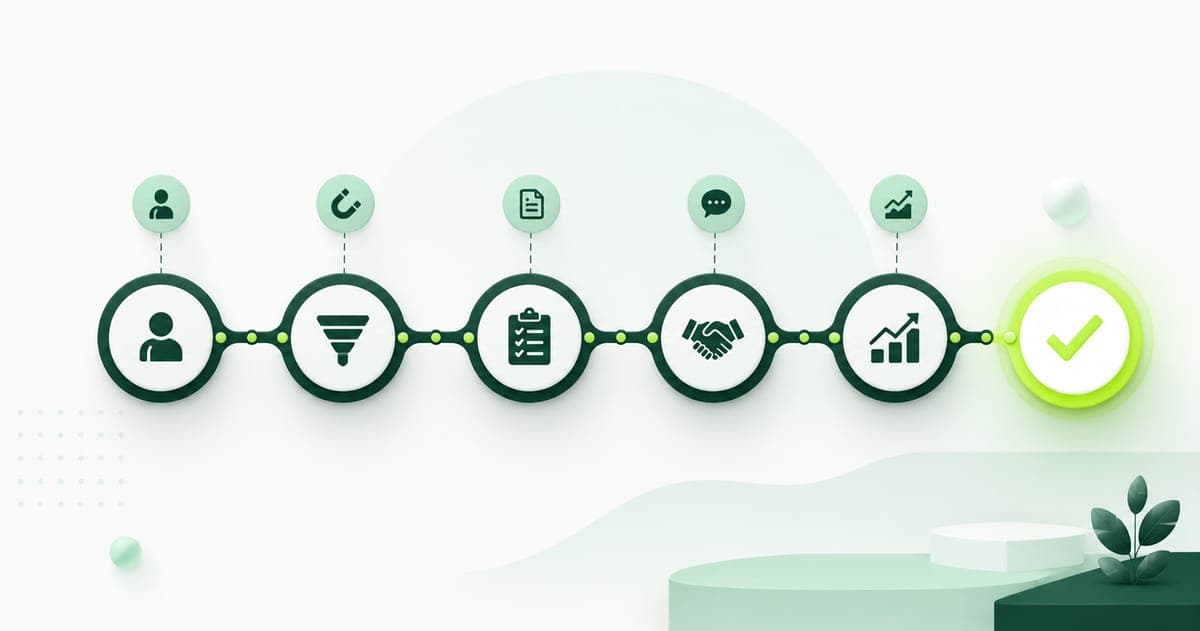
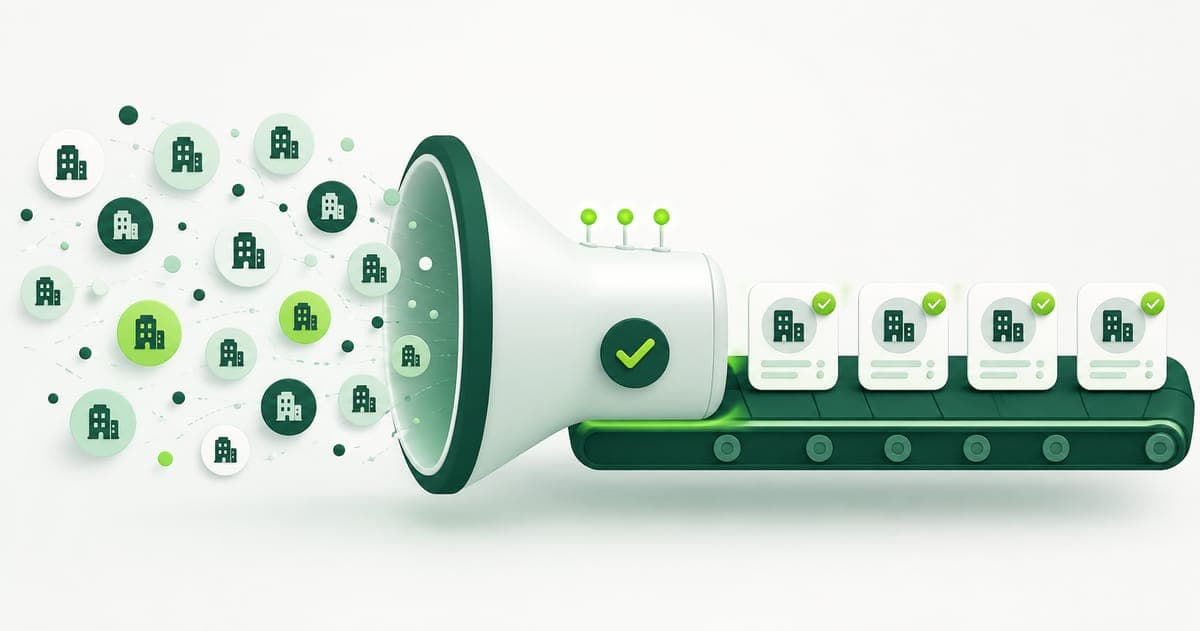
B2B customer acquisition rarely fails because of the product, it usually fails because of the process. As long as new customers arrive through referrals and chance, growth cannot be steered. A system, by contrast, produces conversations repeatably: it is clear who you reach out to, why, through which channel and what happens next. This guide describes acquisition as an end-to-end process, from defining the target audience to finding and scoring fitting companies all the way to consistent outreach and follow-up. The goal is not to do more work, but to point the same effort at the right companies, so activity actually turns into pipeline.
Why a system beats what works by chance
Referrals are great, but they come when they want to. Anyone who wants to plan their growth needs a channel they can steer themselves. A systematic acquisition process is exactly that: you know how many fitting companies you reach out to per week, how many reply and how many turn into conversations. Those numbers create predictability. You see where things stall and can fix it deliberately instead of guessing. Just as important, a documented process also works in a small team and does not live only in one person's head, someone who might eventually be out sick or leave the company.
Step 1: Define your ideal customer profile
The most common mistake is a target audience that is too broad. The sharper your ideal customer profile, the more relevant the outreach and the higher the reply rate. A good profile describes not only industry and size, but also the situation in which your offer is especially valuable. Watch these dimensions:
- Fixed traits: industry, company size, region, business model.
- Triggers: growth, a new role, a new location, new funding, a technology shift.
- Contact: the role that has the problem or decides on the solution.
- Disqualifiers: traits that clearly rule a company out.
Two hundred genuinely fitting companies beat five thousand random ones. A sharp profile saves time in every following step, because you no longer waste your energy on contacts who would never buy anyway.
Step 2: Find fitting companies instead of buying lists
Purchased lists go stale fast and are often sold to many buyers at once. Fresh research per request makes more sense: companies that fit your profile today, with a verified contact and context. That keeps the bounce rate low and makes the outreach credible. Instead of searching a static database that ages from the moment of purchase, you generate up-to-date matches and check every company against its own website. That avoids the two biggest problems of purchased data: addresses that no longer exist, and contacts who left the company long ago.
Step 3: Take data quality seriously
Company data is the raw material of acquisition, and its quality decides everything downstream. A thousand stale addresses are worth less than a hundred fresh, verified contacts with a clear source. You recognize good data quality by four traits: recency, that is, when the record was last checked; verifiability, that is, whether the source can be traced; relevance, that is, whether the company really fits your target profile; and completeness, that is, whether the right contact is included instead of just a catch-all address. Anyone who secures these four points sends less, but hits more often and keeps their sender reputation clean.
Step 4: Prioritize leads with scoring
Not every lead is worth the same. Lead scoring helps you work the most promising ones first, instead of spreading your time evenly. Good scoring combines two questions: does the company fit your ideal customer profile at all, and are there signals that now is a good time? Both together produce a ranking.
- Fit criteria: industry, company size, region, business model.
- Signals: growth, open roles, new locations, technology hints.
- Negative criteria: companies that clearly do not fit, sorted out early.
Scoring every company by hand costs time. An AI fit score takes the groundwork off your plate by checking each company against your profile and assigning a traceable rating with sources. That way you work the best leads first, without hours of manual labor, and still keep control, because you can see the basis for the rating.
Step 5: Reach out across channels and consistently
A single email is rarely enough. A short sequence across email and LinkedIn, personalized and with a clear hook, beats any generic mass send. Email suits the thoughtful first contact, LinkedIn provides visibility and a second, more personal touch, and the phone fits where the offer is complex and the decision-maker is reachable. The important part is to stop immediately on reply and switch to a real conversation. Consistency does not mean pestering: three to four respectful touches make sense, after that it is over. Each message should carry its own small value, instead of just asking whether the last one was read.
Step 6: Pipeline and follow-up
Without follow-up, opportunities leak away. Record which phase a lead is in and what the next step is. What matters is not a perfect tool, but that no promising contact gets lost. Especially in small teams, a simple system is often enough, as long as it is maintained consistently. The decisive thing is the discipline to give every lead a clear next step and a date. A contact with no next step is a dead contact, no matter how well the first conversation went.
The most important metrics
Customer acquisition becomes measurable as soon as you track the right numbers. The most important are the reply rate to your first outreach, the share of qualified conversations and the conversion from conversation to customer. From these values you can tell where your process stalls: a low reply rate points to the audience or personalization, few qualified conversations to a blurry profile, a weak close rate to the offer or the sales process. Anyone who optimizes these spots one at a time improves the overall result step by step, instead of turning the wrong dial.
Common mistakes in customer acquisition
- A target audience that is too broad, with no clear ideal customer profile.
- Purchased instead of freshly researched data, with high bounce rates.
- No prioritization, that is, the same time for good and bad leads.
- Outreach with no real connection to the company.
- Missing follow-up, so opportunities are lost unnoticed.
Combine inbound and outbound wisely
Customer acquisition has two basic directions: inbound, where prospects come to you on their own through content and visibility, and outbound, where you actively reach out to fitting companies. Both have strengths. Inbound works slowly but sustainably and often delivers better pre-qualified inquiries. Outbound works faster and more predictably, because you decide who you reach out to and when. Anyone who bets on only one channel leaves potential on the table. Most successful B2B teams combine both: content builds trust and reach, targeted outreach uses that credibility and gets concrete conversations going. This guide focuses on the outbound part, because it is the fastest to steer.
Ideal customer profile and buyer persona
Two terms are often confused but actually complement each other. The ideal customer profile describes the company: industry, size, region, business model and triggers. The buyer persona describes the person inside that company you reach out to: their role, their goals, their typical worries and the language in which they think about their problem. You need both. The profile tells you which companies to select, the persona how to phrase the message. A CEO responds to different arguments than a department lead, even at the same company. Anyone who separates the two levels cleanly and serves each deliberately raises the hit rate noticeably.
Find the right person to contact
One of the most common hurdles is simply reaching the right person at all. A message to a general info address almost always leaks away. It makes more sense to deliberately research the person who has the problem or decides on the solution, and to reach out to them directly. In smaller companies that is often the founder or CEO, in larger ones the relevant department. The important part is to aim neither too high nor too low: aim too high and you get passed down, start too low and you reach nobody with decision power. A short bit of research per company, on who holds the right role, pays off in every single outreach.
Use triggers systematically
Triggers, often called trigger events, are events that suddenly make a topic relevant. These include growth, new locations, leadership changes, funding rounds, new products or regulatory changes. Anyone who ties their outreach to such events hits the right moment and comes across as attentive rather than arbitrary. The trick is not to discover triggers by chance, but to watch for them systematically: which signals suggest a company has your need right now? Building those signals into the acquisition process turns timing from a matter of luck into a steerable factor and lifts reply rates noticeably.
Patience, frequency and staying the course
Customer acquisition is an endurance game. Few deals happen on the first contact, and many teams give up right when it gets interesting. A constant frequency is decisive: better to reach out to a manageable number of well-prepared companies every week than one big wave per quarter and then nothing for months. Consistency makes the pipeline predictable and prevents the typical swings between full and empty weeks. At the same time it takes the discipline to let hopeless contacts go and point the energy at the promising ones. Staying the course does not mean chasing everyone at any cost, it means keeping the process running reliably.
Clarify responsibilities in the team
As soon as more than one person does outreach, you need clear responsibilities. Who researches, who reaches out, who runs the conversations, who maintains the pipeline? Without clear roles you get duplicate outreach, forgotten follow-ups and friction. In small teams one person can take several roles, as long as the handoffs are documented cleanly. The important part is that the process does not live in one person's head, but is recorded so it can be traced. That keeps acquisition stable even when someone is out, on vacation or leaves the company, and new team members get up to speed quickly.
Scale without losing quality
The hardest moment comes when the process works and you want more. The temptation is to simply increase volume and sacrifice personalization. That is exactly what tips the results: more messages at falling relevance means lower reply rates and a strained reputation. Clean scaling means speeding up research and personalization without dropping them. This is where AI and automation help, by taking over the time-consuming groundwork and concentrating human attention where it counts. That way the number of conversations grows without every single outreach losing quality.
How Firmeo powers the process
Firmeo researches fitting companies live from public sources, checks them against their own website to guard against hallucinations and assigns each lead an AI fit score with sources. You see immediately which matches fit best, and you bring email and LinkedIn outreach from your own mailbox together in one platform, with volume ramp-up and an immediate stop on reply, EU-hosted and GDPR-compliant. That turns random outreach into a predictable process that even small teams can run without an expensive tool stack, credit-based instead of per seat.
Conclusion
B2B customer acquisition becomes predictable as soon as it stops being a matter of chance. The thread running through this guide is simple: first select the right companies, then research and prioritize cleanly, finally reach out with relevance and follow up consistently. Each step builds on the previous one, and weakness in one place runs through the whole process. A sharp ideal customer profile is the single most important lever, because it makes every following decision easier. Fresh, verifiable data beats any purchased list, and a traceable lead scoring ensures your time flows into the most promising contacts first.
Just as important as the individual steps is the mindset behind them: better to work a few companies really well than many superficially. Anyone who works consistently, knows their metrics and scales with AI and automation in the right places, without sacrificing quality, builds a reliable growth channel. That channel is independent of referrals, faster than purely organic visibility and steerable like almost no other. In the end, success is not decided by a single trick, but by the discipline to repeat a thoughtful process week after week and to keep improving it based on the results. That is exactly the difference between teams that hope for luck and those that hold their own growth in their hands.