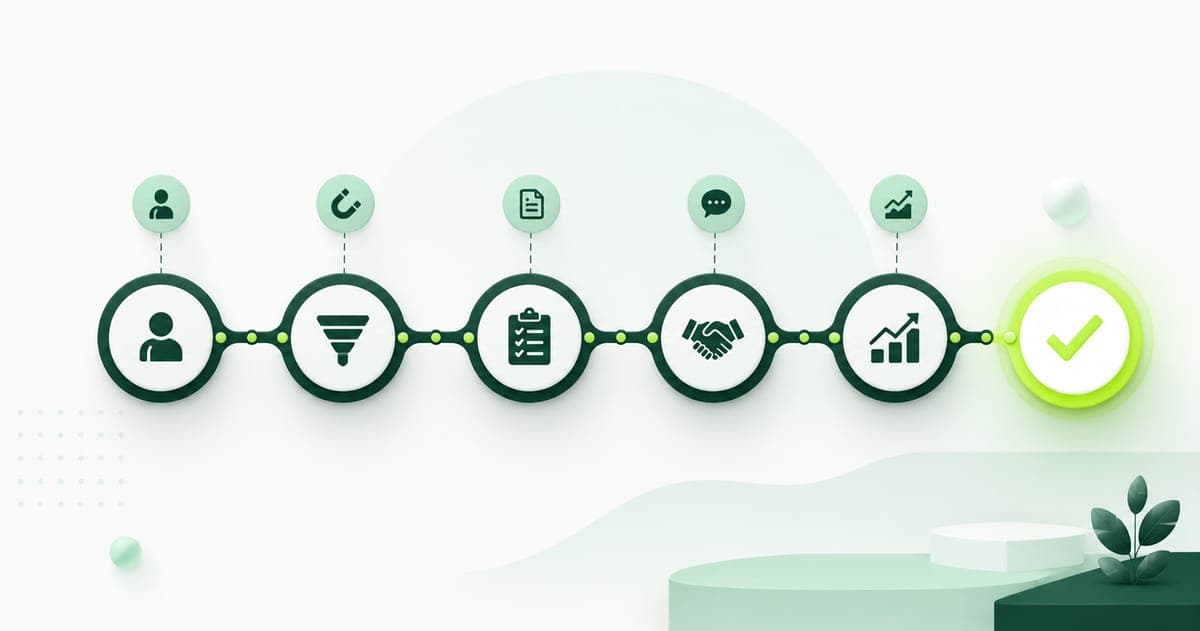

Social selling means building relationships through social networks, in B2B above all LinkedIn, that later lead to business. It is the opposite of cold mass outreach: you become visible, deliver value and are present when a need arises. Anyone who mistakes social selling for a shortcut to a quick sale and spams strangers with pitches achieves the opposite. Understood correctly, it is a medium-term build that ensures your name comes up when a problem turns acute in your audience. This guide shows the building blocks: from your own profile to visibility through content all the way to the first message and the connection with targeted direct outreach.
What social selling is and what it is not
Social selling is the systematic build of visibility, relationships and trust through social networks, until connections turn into conversations and from there into business. It is not a synonym for sending sales messages to strangers. The difference is fundamental: in social selling you deliver value first and ask later, in the flat direct message you ask immediately and never deliver. Social selling therefore works more slowly, but more sustainably. It builds a reserve of trust you draw on when the right moment comes, instead of having to start every contact from zero.
The profile as a landing page
Before you reach out to contacts, look at your own profile. It should make clear who you help and how, not just list your job titles. Whoever receives your message looks at the profile first, and in those few seconds it is decided whether you are taken seriously. Treat your profile like a landing page: the headline describes the value you provide for your audience, not just your position. The about section explains in a few sentences which problem you solve and for whom. A professional photo and a meaningful banner round off the first impression. The profile is the foundation for everything else, because every bit of visibility leads back to it.
Visibility through value
Visibility on LinkedIn does not come from advertising, it comes from helpful content and genuine participation. Anyone who regularly shares useful knowledge and comments substantively stays in the audience's mind.
- Share insights and experiences that genuinely help your audience, instead of just presenting wins.
- Comment visibly and substantively on relevant posts, not with platitudes.
- Be consistent rather than active only when you happen to want to sell something.
- Show a stance and personality, because in B2B people buy from people.
From connection to conversation
When you do reach out, do it with a hook, not a pitch. A connection with an honest reason, followed by genuine interest, opens more doors than any pushy sales message. Patience pays off. A good first message ties to something concrete, a post, a shared connection, a change at the other person's company, and does not ask for a meeting right away. The goal of the first touch is not the sale, it is the start of a dialogue. Sell too early and you burn the contact, wait too long and you miss the moment. The art is to stay present and helpful until the other person shows interest themselves.
Connect social selling with direct outreach
Social selling and targeted outreach do not exclude each other, they reinforce each other. Social selling builds the visibility and the trust, targeted direct outreach gets concrete conversations going faster. Anyone who combines both connects not with random contacts but deliberately with the right decision-makers and reaches out with a real hook. That creates a cycle: your content makes you known, your targeted outreach uses that recognition, and every conversation in turn raises your credibility. The decisive thing is that both paths follow the same thread and feel consistent.
Common mistakes in social selling
- Selling immediately, instead of delivering value and building trust first.
- A profile that only lists job titles, instead of showing the value for the audience.
- Becoming active only when there is something to sell right now.
- Automated mass messages with no real hook, which come across as spam.
- Impatience, that is, giving up before visibility and trust could take effect.
How long social selling takes
Social selling is a medium-term build. Visibility and trust grow over weeks and months, not overnight. That is not a drawback, it is the reason it works: what grows slowly is hard to copy and carries for a long time. Anyone with realistic expectations stays the course, instead of giving up frustrated after two weeks. At the same time you do not have to wait until the build is finished, because targeted direct outreach can already start concrete conversations in parallel. The combination of patient relationship building and targeted outreach delivers short-term conversations and long-term substance at the same time.
The Social Selling Index and what it tells you
LinkedIn itself measures, with the Social Selling Index or SSI, how active and effective a profile is in the sense of social selling. It rates four areas: build your own brand, find the right people, engage with insights and nurture relationships. The SSI is a useful orientation value, but not an end in itself. A high score correlates with activity but guarantees no deals, and anyone who optimizes only for the metric easily loses sight of the actual goal. It makes sense to use it as a rough compass: it shows which of the four areas is neglected and so hints at what to work on next.
Content formats that work on LinkedIn
Visibility comes from content, but not every format works equally well. What works best are posts that draw on real experience and help concretely, instead of staying general. Several formats have proven themselves, and you can alternate them:
- Practical insights: concrete learnings from your work, including mistakes and what you learned from them.
- Short how-tos: a clearly defined problem of your audience solved step by step.
- Observations and opinions: a well-reasoned stance on a development in your industry.
- Customer stories: anonymized or with permission, because real examples convince more than claims.
A simple content calendar
Consistency beats perfection. Anyone who plans one elaborate post a month and then does not write it achieves less than someone who shares a short, honest thought every week. A simple content calendar helps you stay the course without overwhelming yourself. Set a realistic pace, say one or two posts per week, and collect topics continuously instead of starting from zero each time. Good ideas often come from customer conversations, frequent questions or current developments. Anyone who notes such prompts always has material. The calendar is not a corset, it is a railing that keeps visibility from sinking under daily routine.
Commenting as an underrated strategy
Not everyone has to write their own posts daily. An often underrated but effective strategy is commenting deliberately on other people's posts. A thoughtful comment under the post of a potential customer or industry peer creates visibility with exactly the right audience, often more than your own post with little reach. The important part is that the comment is substantive and adds something, instead of just agreeing. Anyone who comments smartly on a regular basis is perceived as a competent voice and builds relationships long before direct outreach becomes necessary. Commenting is social selling in miniature and costs only a few minutes a day.
From profile visit to connection
LinkedIn shows you who visited your profile. These visitors are a valuable, often ignored signal: someone took an interest in you without you having to do anything. A friendly, on-topic connection request to a profile visitor meets existing interest and is accepted more often than a cold request. Anyone who likes or comments on your posts has also identified themselves as interested. Using these warm signals systematically is one of the simplest ways to turn passive visibility into active contacts, without falling into the trap of the cold mass request.
Groups, events and other channels
Social selling is not limited to your own feed. LinkedIn events, professional groups and shared events offer further touchpoints with the audience. Anyone who attends an event or hosts one themselves creates a natural occasion to connect and reach out. Taking part in relevant discussions also positions you as someone with something to contribute on the topic. The important part is to keep the same principle everywhere: deliver value first, build the relationship, and only sell last. These additional channels are no substitute for consistent content, but they broaden the base on which later conversations build.
Anchor social selling in the team
When a whole team does social selling, the reach multiplies, but only if it happens in a coordinated way. Every employee with a sharpened profile and their own voice becomes an ambassador. The important part is that no coordinated uniform posts emerge, because nothing comes across as less credible than ten colleagues sharing the same text. It is better to set shared topics but leave each person room for their own perspective. That creates a many-voiced, authentic presence instead of a transparent campaign. A team that shares real knowledge builds, together, a visibility that no single profile could reach alone.
Measure success without getting lost
Social selling can be measured, but not every number matters equally. Likes and reach are nice, but say little about business. More telling are the number of relevant new connections, the conversations that arise from LinkedIn, and ultimately the customers won from them. Because social selling works over the medium term, the measurement needs patience and a longer horizon than a single campaign. Anyone who looks for direct closes too early underestimates the value of the visibility built up. It makes sense to track a few key numbers over months and align your activity with them, instead of being unsettled by short-term swings.
How Firmeo complements social selling
Social selling and targeted outreach can be combined. Firmeo researches fitting companies and decision-makers live from public sources, checked against the website, so you connect with and reach out to exactly the right people instead of casting a broad net. LinkedIn outreach and email run together from one platform, with an AI fit score and sources, so every outreach has a real hook. That way you build visibility through content and start concrete, well-prepared conversations in parallel, EU-hosted and GDPR-compliant.
Conclusion
Social selling is no trick and no shortcut, it is a stance: deliver value first, be visible and helpful, and only then sell. On LinkedIn it all starts with your own profile, which, like a landing page, makes the value for the audience clear. On top of that build visibility through helpful content, substantive commenting and the patient nurturing of relationships, until connections turn into conversations. Anyone who uses warm signals like profile visits and reactions turns passive attention into active connections, without falling into the trap of the cold mass request.
The greatest strength of social selling shows in the combination with targeted direct outreach. Content builds trust and reach, targeted outreach uses that credibility and gets concrete conversations going faster. That creates a cycle in which both paths reinforce each other. Patience matters: social selling works over the medium term, and precisely because it grows slowly, it is hard to copy and carries for a long time. Anyone with realistic expectations, who tracks a few meaningful metrics over months and stays consistent, builds a position on LinkedIn that no ad budget can buy. In the end people buy from people they trust, and that trust is the real result of good social selling.
For teams this effect multiplies, when everyone becomes an ambassador with their own voice and a sharpened profile, instead of sharing coordinated uniform posts. A many-voiced, authentic presence reaches a visibility that no single profile manages alone. Social selling is therefore not a short-term channel for quick closes, but an investment in visibility, relationships and reputation that pays off over time and makes every targeted outreach more effective.
Anyone starting with social selling today should not be discouraged by the apparent slowness. The first weeks often feel unspectacular, because visibility and trust grow invisibly before they show up in conversations. This is exactly where those who stay the course part ways with those who give up too early. A good start is modest: sharpen the profile, deliberately connect with a handful of relevant decision-makers, share an honest thought once a week and comment substantively on the audience's posts. From these small, consistent steps a presence emerges over months that opens doors long before you ask for anything. Combined with targeted, well-researched direct outreach, this becomes an acquisition approach that delivers short-term conversations and long-term substance at once, while staying human.